Post-operative & Orthopaedic Rehabilitation
The period following surgery can often be distressing.
Our HCPC-registered physiotherapists work closely with patients to reduce the risk of complications while improving mobility, function, muscle strength, balance, flexibility and stamina — delivered directly to your door.
Our Services
- Elderly Mobility & Falls Prevention
- Stroke & Neurological Rehabilitation
- Post-operative Rehabilitation
- Musckuloskeletal & Orthoapeadic rehabilitation
- Physiotherapy in Care Homes
- Case Management
- Cancer- related Rehabilitation
- Paediatric Physiotherapy
- Orthopaedic Physiotherapy
- Personalised Rehabilitation Plans
- Private Physio
- For Care Homes
Our Services
- Elderly Rehabilitation & Falls Prevention
- Stroke & Neurological Rehabilitation
- Post-Operative & Orthopaedic Rehabilitation
- Muscle and Joint Injuries
- Physiotherapy in Care Homes
- Physiotherapy for Frailty & Deconditioning
- Physiotherapy after Hospital Discharge
- Case Management
- Cancer-Related Rehabilitation
- Paediatric Physiotherapy
- Personalised Rehabiliation Plans
- Private Physio
- For Care Homes

What is Post-operative Physiotherapy ?
Expert Rehabilitation After Every Type of Surgery
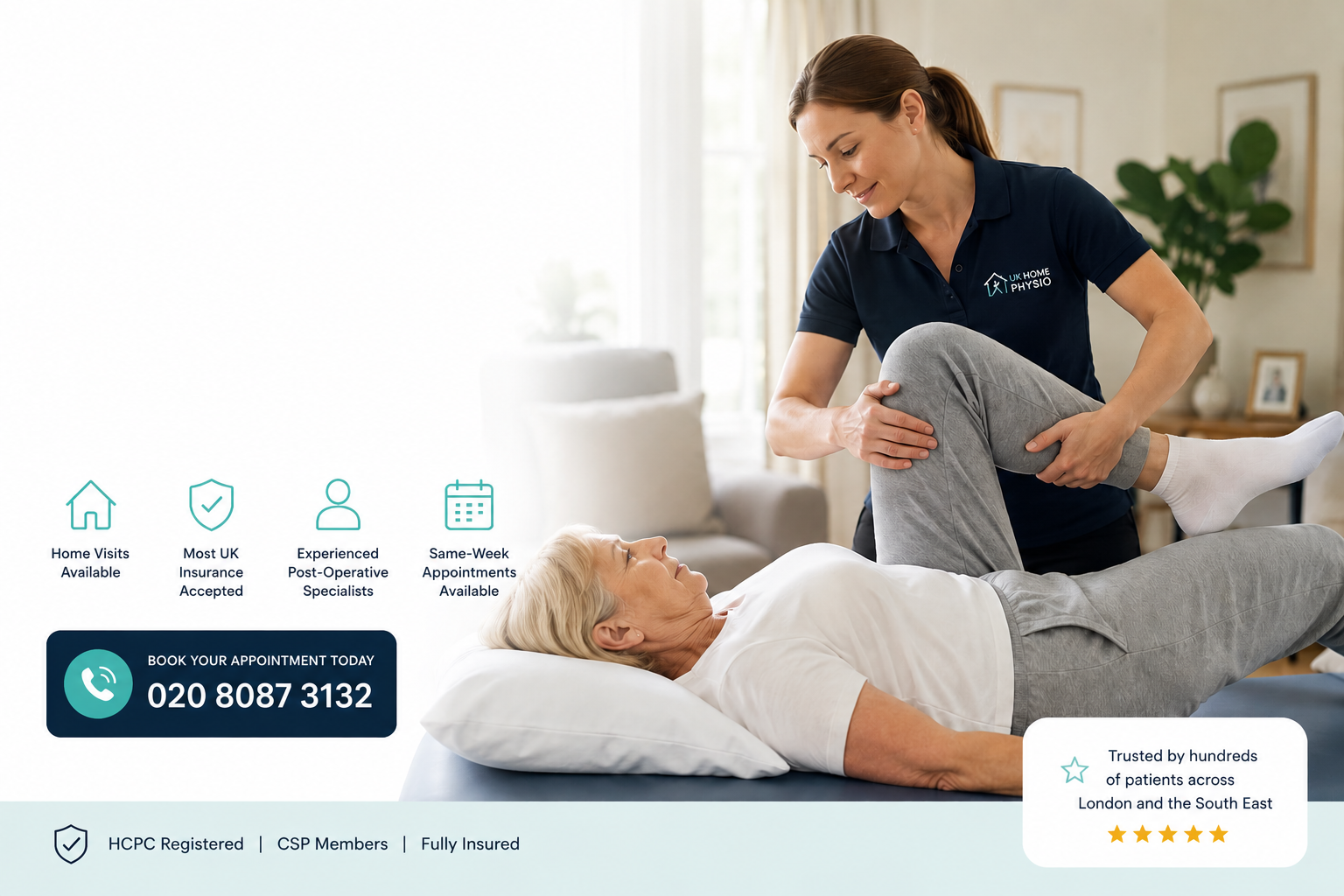
Home physiotherapy plays a crucial role in post-operative recovery after all types of surgeries, including orthopaedic, neurological, thoracic and abdominal procedures.
We understand the challenges of surgical recovery and work closely with each patient to create a personalised rehabilitation journey. Our team specialises in pre- and post-operative rehabilitation, including joint replacements, spinal surgeries, multiple fractures and recovery following road traffic accidents.
We provide a dedicated team of expert home physiotherapists, occupational therapists and rehabilitation assistants to support you in returning to optimal function — at a pace that is right for you.
Physiotherapy for Post-Surgical Recovery
We Support Recovery Across All Surgery Types
From orthopaedic procedures to complex neurological and thoracic surgeries, our physiotherapists have the specialist expertise to support your recovery safely and effectively at home.
Orthopaedic Surgeries
Physiotherapy is essential after orthopaedic procedures such as knee, hip and shoulder joint replacements, as well as surgical fixation of fractures, including the use of external fixators.
Neurological Surgeries
Rehabilitation is important following surgeries involving the nervous system, including the brain, spinal cord and peripheral nerves — such as spinal decompression surgeries and the removal of adenomas or tumours.
Thoracic Surgeries
Physiotherapy supports recovery after surgical procedures involving the heart and lungs, such as Coronary Artery Bypass Grafting (CABG) and valve replacement surgeries.
Abdominal Surgeries
Whether performed laparoscopically or through open laparotomy, physiotherapy helps improve breathing, mobility, posture and overall recovery following abdominal procedures.
How We Support Your Recovery
What Our Physiotherapists Focus On
Following a comprehensive assessment, your physiotherapist will design a personalised rehabilitation programme tailored to your individual needs, with the goal of achieving full recovery. We focus on the following areas:
Strength & Flexibility
Improving flexibility and muscle strength to restore pre-surgical function and capacity.
Balance Retraining
Progressive balance retraining to reduce falls risk and restore stability and confidence.
Mobility Progression
Structured mobility practice and progression to restore safe, independent movement.
Joint Range of Motion
Targeted techniques to enhance joint range of motion and prevent post-operative stiffness.
Pain Reduction
Hands-on and exercise-based strategies to manage post-surgical pain effectively.
Accelerated Recovery
Evidence-based techniques to promote healing and support a faster return to daily activities.
Functional Independence
Rebuilding the ability to perform everyday tasks safely and confidently, from dressing and washing to climbing stairs and getting in and out of bed.
Goal Setting & Progress Monitoring
Regular review of individual goals and measurable progress, ensuring the rehabilitation programme remains on track and adapts as recovery advances.
Hands-On Treatment Approach
Treatment includes hands-on therapy techniques to address pain, stiffness and soft tissue restrictions.
Personalised Rehabilitation Programme
Your Recovery Plan, Step by Step
Every programme is individually tailored to the type of surgery, personal goals and stage of recovery. Here is what your rehabilitation may include:
- Personalised exercise plans to improve muscle strength and joint range of motion
- Assessment of walking aids and mobility equipment to ensure safe and appropriate use
- Outdoor mobility assessment and practice
- Balance and gait retraining to improve stability and reduce fall risk
- Goal-focused rehabilitation to ensure return to pre-surgery activities
- Gait training and structured mobility progression
- Functional training to restore independence in activities of daily living
- Stair assessment, practice and safety training
- Advice on pain management strategies
- Structured support to consolidate and sustain the gains made throughout rehabilitation, ensuring strength, mobility and function are preserved long-term
Personalised Rehabilitation Programme
Your Recovery Plan, Step by Step
Lorem ipsum dolor sit amet, consectetur adipiscing elit. Ut elit tellus, luctus nec ullamcorper mattis, pulvinar dapibus leo.
🔥
Pain & swelling
💪
Decreased muscle strength
🧑🦯➡️
Reduced mobility & flexibility
🤧
Reduced stamina & exercise tolerance
🩸
Risk of blood clots
⚖️
Balance & coordination issues
🦴
Joint stiffness
🚶♀️
Difficulty walking or performing daily activities
🏋️♂️
Muscle tightness & reduced range of motion
😴
General weakness & fatigue
🫁
Breathing difficulties & reduced lung capacity
🧘
Poor posture & altered movement patterns
Home Physiotherapy After Surgery
When Should Physiotherapy Start?
The timing of physiotherapy input is critical to achieving the best possible outcome. Both before and immediately after surgery, physiotherapy plays a vital role.
Pre-operative Physiotherapy
Pre-operative physiotherapy prepares and conditions the musculature which significantly improves outcomes post-surgery. By building strength and flexibility before the procedure, recovery is faster and more effective.
Post-operative Physiotherapy
After the surgical procedure, physiotherapy should start as soon as possible to prevent complications and achieve the best clinical outcome. Early physiotherapy helps manage pain, improve mobility and muscle strength, reduce stiffness and promote a speedy recovery.
Frequently asked question
Yes. Our physiotherapists can visit you at home, in a care home, or at a location of your choice to provide personalised rehabilitation.
The frequency depends on your surgery type and recovery progress. The Physiotherapist will make tailored recommendations based on your rehabilitation goals, which will be agreed upon mutually with you to ensure the best possible recovery plan.
During your first visit, the physiotherapist will assess your condition, review your surgery and medical history, and discuss your recovery goals. A tailored treatment plan will then be developed including specific exercises and hands-on therapy.
The duration varies depending on the type of surgery and individual recovery targets and progress. It can vary from few weeks, to longer-term rehabilitation for optimal results.
The improvements may be noticed within a few sessions, although recovery time varies based on the individual healing process. Consistent physiotherapy input and following your home exercise plan is crucial to achieve optimal progress.